Defining Uncertainty at the Boundary of Live Program Blocks
In live event environments, the highest failure rates occur precisely between planned segments rather than within steady-state presentations. Keynote speakers frequently alter their closing statements, panel discussions finish unexpectedly early, or remote guests experience uplink latency right at the point of introduction. When operators simply wait for a predetermined line in the script, hesitation cascades through lighting, audio, and visual playback channels simultaneously.
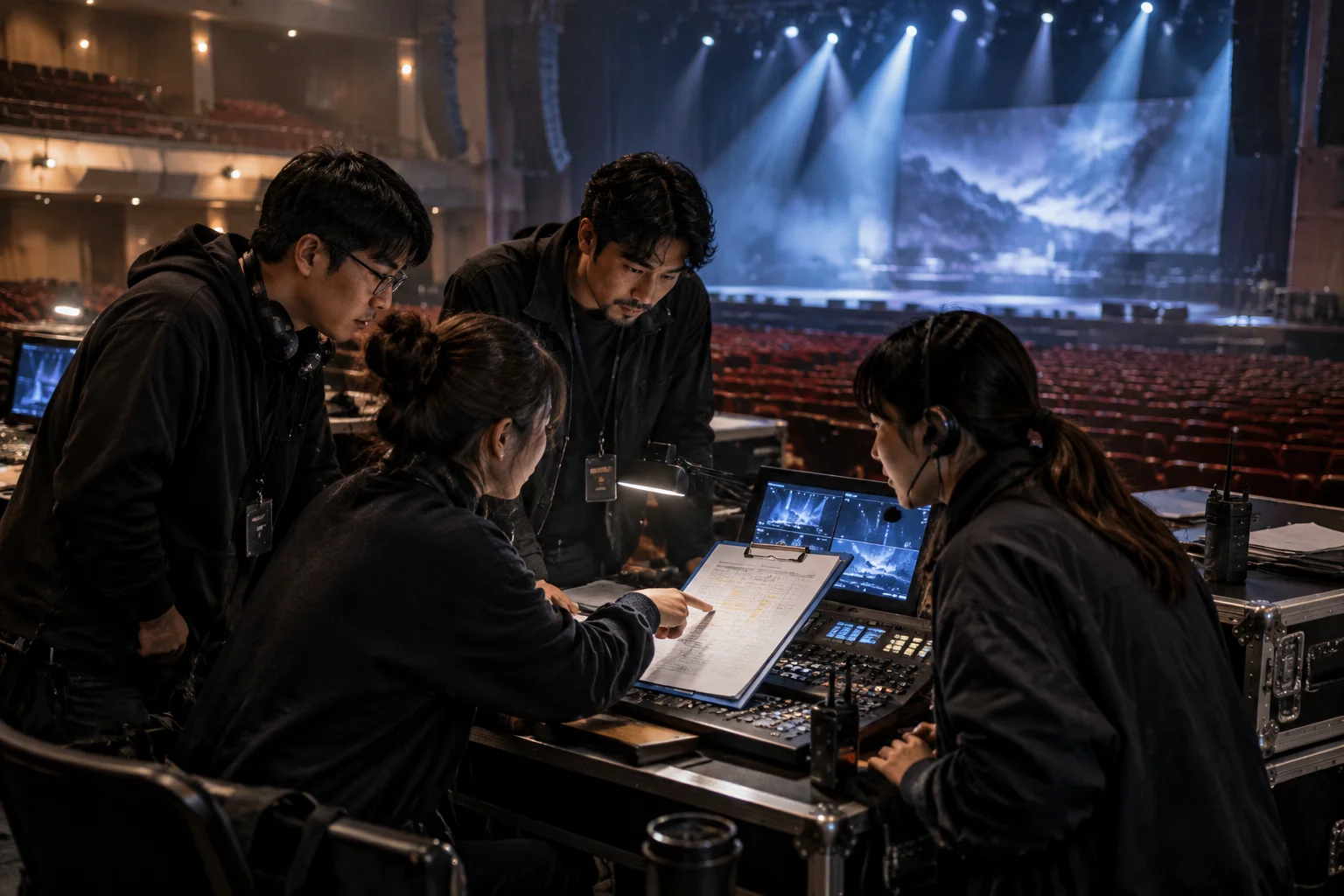
Rehearsing uncertain transitions demands isolating these juncture points into standalone operational drills. Rather than re-running thirty minutes of familiar remarks, the production desk isolates the final forty seconds of a block and subjects it to three distinct exit conditions: an early departure, an extended overrun, and an abrupt visual cue override. Drilling these boundaries clarifies who commands the switch and what holding state displays across the hall while the next presenter walks up.
Establishing Safe Holding States and Visual Anchors
When a transition unfolds unpredictably, immediate cutovers to unverified assets often produce jarring visual glitches or misfired introduction reels. Implementing a standardized intermediate state—often an ambient conference holding background or a speaker-neutral transition slate—gives the control desk breathing room to confirm stage positions before firing high-priority cues.
During technical checks, operators configure dedicated macro buttons that trigger this neutral holding look in a single keystroke. Rehearsal teams deliberately call simulated surprises—such as calling a presenter absent or swapping speaking order—to evaluate how fast the video operator engages the safety state and how seamlessly the audio lead mutes podium lines without deadening room ambient sound.
Operational Rehearsal Benchmarks
- Safety State Engagement
- < 0.8 Seconds
- Verbal Call Protocol
- Standby → Confirm → Go
- Buffer Slide Retention
- Default 100% of Blocks
- Rehearsal Pass Rate
- Minimum 3 Boundary Drills
Communication Discipline Across Intercom Channels
Unclear chatter on production intercom circuits compounds ambiguity during tense program transitions. Operators who guess cues based on visual movement across stage monitors routinely fire roll-in packages before the speaker reaches the podium. Clear protocol requires a single designated caller—typically the stage manager or show caller—to issue distinct “standby” and “go” directives that override visual assumptions.
During transition rehearsals, the crew deliberately introduces silent pauses and out-of-order gestures to test whether technicians wait for the explicit command. If an uncalled cue triggers, the sequence stops immediately and resets until operators execute based solely on verified communication lines and documented register items.