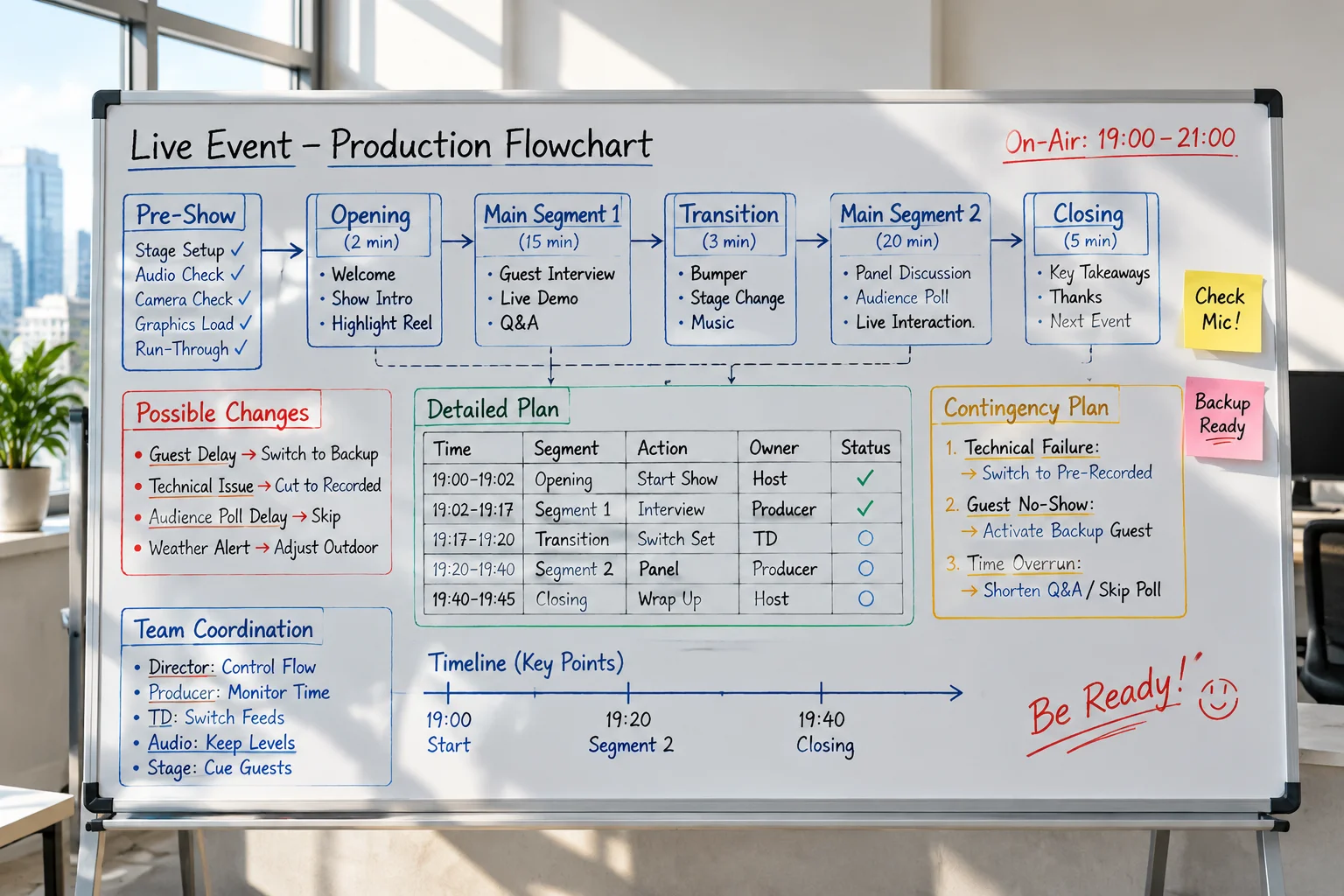
The Architecture of Non-Linear Event Sequences
Live stage management encounters severe friction whenever a production crew assumes a timeline will unfold linearly. Case G represents a classic hybrid symposium where keynote deliveries, real-time live demonstrations, and audience interaction paths intersect within a tight ninety-minute schedule. In this environment, an operator cannot simply rely on pressing next on a unified deck. Stage directors must coordinate audio bed fades, screen preset adjustments, and confidence monitor changes simultaneously, while speakers skip entire sections or linger on introductory remarks.
By breaking the session into modular trigger clusters, the control desk isolates each functional component. When the lead presenter moves directly into the interactive demonstration earlier than scheduled, the console operator fires an isolated sub-register rather than jumping blindly across thirty slides. This architectural distinction preserves media synchronization across stage projection systems and prevents jarring graphical cutoffs before live audiences.
Handling Spontaneous Sequence Branching
During the Case G execution, the panel discussion shifted dramatically when an unannounced video segment was requested from the floor. Without predefined branch markers, such disruptions inevitably cause blank screens, audio mismatches, or frozen visual states. The cue architecture solved this challenge through decision nodes: every primary cue contained two distinct child states, designated as Forward Advance and Hold Loop.
When the moderator called for the unexpected playback clip, the operator triggered the secondary routing macro. The primary screen remained locked on an elegant thematic backdrop, while the routing engine prepared the media buffer on auxiliary output channels. The transition occurred seamlessly within three seconds, completely hiding the spontaneous coordination from the audience and maintaining broadcast integrity throughout the room.
Case G Operational Parameters
- Total Planned Cues
- 84 Discrete Triggers
- Dynamic Decision Points
- 6 Pre-mapped Branches
- Transition Buffer Margin
- 4.5 Seconds Nominal
- Desk Response Latency
- < 350 Milliseconds
Post-Event Analysis and Rehearsal Verification
Careful review of the post-show logs revealed that seventy percent of the session followed non-standard timing intervals. Despite these drastic deviations from the original rehearsal timetable, not a single cue collision occurred. The presence of visual confirmation indicators on the primary control surface enabled the operator to verify cue status before pushing updates to downstream displays.
Documenting these decision points within a structured cue register allows future operators to replicate the same level of calm execution. Systematic rehearsal of branches rather than linear run-throughs guarantees that when stage variables fluctuate, the control desk maintains absolute clarity over every visual, audible, and structural event asset.